Showcase
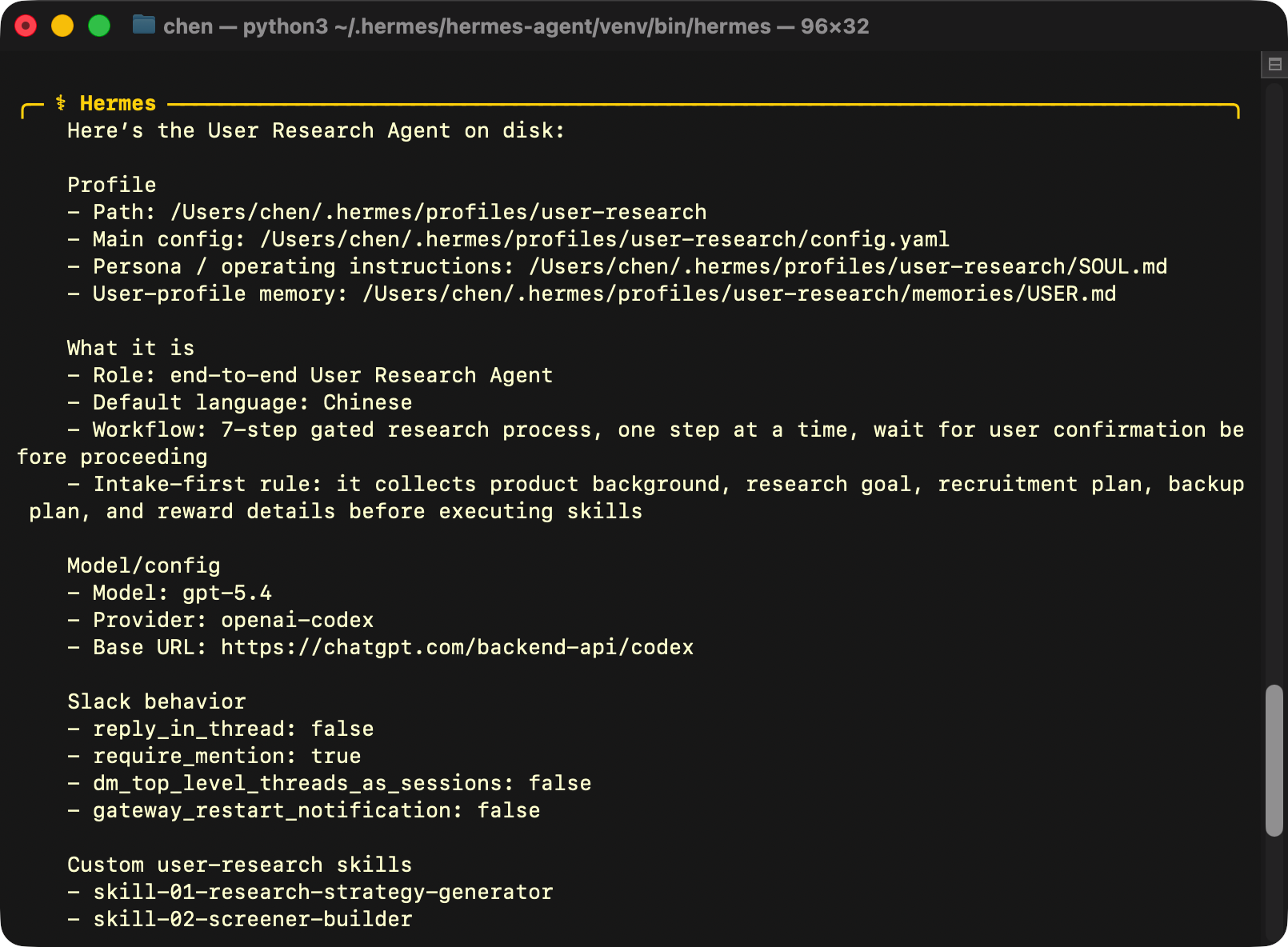
Introduction: An enterprise-deployable agent that runs a complete user research cycle on demand — filling the gap for teams without a dedicated research team, and turning each completed study into reusable organizational knowledge.
Implementation: The process is documented in the tutorial
Results:
- Reduced a full research project from 6 weeks to 2 weeks — validated with a completed cycle
- Automates the full research cycle through 7 skills, with no dedicated research team required
- The AIGC product was subsequently shut down due to low ROI — protecting the company from further investment with no clear path to return
- Turned the full research process into a User Research Agent, deployable on enterprise for the whole organization to use
Background
When I joined the product team, the AIGC product had already been live for a year — but ROI was consistently low and the team had no clear direction for improvement. As an AI Product Manager focused on growing revenue, I analyzed the product data and realized our understanding of target users was nearly nonexistent: everything we knew was based on internal assumptions, with no direct contact with actual users.
I proposed launching a new User Research Project — but with no dedicated research team in place, I drew on my experience from 5 previous research projects — run either independently or with a small team — and decided to take it on myself, using AI to help me work through it more efficiently.
Problem Identification and Opportunity
The problem:
- The team had almost no understanding of user behavior, user tasks, or user profiles. So I needed to launch a research project to collect user feedback and directly validate the product's value.
Opportunity:
- By understanding AI creators' workflow through interviews, we can identify which steps our product can better support — and focus improvements where they matter most
- Based on user pain points and satisfaction levels, we can determine how to improve the product experience
Success Metrics
-
Time: Completed within two weeks.
-
Cost: Budget planned for 5–7 user interviews at $500–$700 total; final spend came in under $500.
-
Quality:
- Understand AI creators' content creation workflow at each step
- Collect user feedback on product pain points and potential opportunities
- Validate product-market fit through competitive analysis
The Solution
The Value:
While optimizing this product, I used vibe coding to prototype three different product solutions — but had no way to determine which one was best. Without direct user input, I'm not the decision maker. Optimizing the product without understanding users only increases investment without clear output, leaving the team without a way to set priorities.
Research plan:
Identified 5 North American AI Creators — the product's target audience — and conducted in-depth one-on-one online interviews with each.
Research dimensions:
- Learning from AI Creators: Through interviews, learning directly from AI Creators to understand their workflow and the full video creation process in depth
- Pain points and experience: Identify where friction occurs and where our product can provide meaningful support
- Market insights: Understand how AI Creators find clients and take on projects — a community that is difficult to reach through conventional channels
Execution Process
To get meaningful insight into how users actually think and behave, I chose qualitative research over a simple survey. A quantitative approach can capture what users do — but not why, and not the decision-making process and factors behind their behavior.
-
Research Strategy: Define the research goal, methodology, and recruitment plan. Use AI to generate the strategy document.
-
Candidate Screening: Design a questionnaire with AI for initial candidate screening. Review responses and find candidates who fit the research criteria.
-
Candidate Invitation: Send personalized invitations to selected candidates, including session time, reward details, Zoom link, and NDA.
-
Mock Interview: Work with AI to write a comprehensive interview guide covering all questions for the moderator. Rehearse the guide a few times before going live.
-
Online Research Interview: Conduct one-on-one online sessions with each candidate to collect feedback, with audio recording and transcript documentation.
-
User Follow-up: After all interviews are complete, send a personalized thank-you email to each candidate with the reward attached. Use the email to follow up on any unanswered questions or points that need clarification.
-
Interview Analysis: Work with AI to analyze all interview transcripts, identifying patterns to produce individual summaries, cross-interview synthesis, and key takeaways.
-
Report: Based on a full understanding of the research, direct AI to draft the report — then present the findings to stakeholders, directly answering every key question defined in the research strategy.
Based on the full research cycle above, I used the Hermes Agent framework to create a dedicated User Research Agent — training all the accumulated materials, decisions, and outputs into it. The next time anyone on the team needs to run user research, they can call the Agent directly to assist with the full cycle, from generating materials to drafting the final report.
The Agent is designed to adapt across different research projects — each run can be adjusted based on the specific research type and context. All collected information and deliverables are stored on the company's internal AI Platform, building organizational Knowledge Assets from Agent Memory and accumulated Deliverables — turning individual research work into a shared resource that improves efficiency across the whole organization.
Deliverables
- Research Strategy Document
- Online Research Interview Transcript
- Research Report
- Hermes Agent — User Research Agent
Results
Finding:
The research revealed that demand for the AIGC product among target users was limited, and most unmet needs had already been addressed by competing products — explaining why the metrics had consistently underperformed despite sustained investment.
AI Creator Workflow:
Through interviews, we mapped the full content creation process AI creators follow when producing videos for clients:
- Receive project requirements and source materials from the client
- Use an LLM to generate a video script, then edit it manually
- Input the script into the AIGC product to generate multiple images
- Use those images to generate separate video clips, each corresponding to a different scenario in the script
- Import the clips into CapCut for manual video editing
- Deliver the final video to the client
User Pain Points:
Three recurring friction points emerged across interviews:
- Uncontrollable quality: Text-to-video models are inherently prone to hallucination — the generated content is uncontrollable, and results frequently miss the intended vision with no reliable way to correct them
- Character consistency: When a video involves a specific person or character, users have no reliable way to keep that character visually consistent across clips
- Inefficient workflow: Because of model instability and character inconsistency, any small change forces users back into CapCut for manual re-editing — making the entire process extremely time-consuming
Impact:
- I presented the findings to the stakeholders. By that point, the company had invested a significant amount of capital with no clear path to revenue. The research validated the decision — confirming there was no viable market for the product.
- Initiating and completing this research ahead of further investment helped the company avoid committing additional budget to a product the market had already moved past.